Three Times the Output, If I Can Find the Session
“The palest ink is better than the best memory.” – Chinese proverb
I have worn most of the hats there are in a technology company over the last few decades: CTO, VP of Engineering, Chief Architect, CPO, Principal Engineer. These days at Flipboard and Surf that means my week is a mix of production debugging, writing and reviewing code, data questions, vendor and legal paperwork, planning, and helping the rest of the company get the same leverage out of AI that I do. I use Claude Code for virtually all of it. Not just the engineering parts.
This post is about one habit that made that dramatically more effective, the problem the habit created, and the small tool I built to fix it.
One session per subject, not one session per day
My first instinct was to treat a session like a terminal: open it in the morning, throw everything at it, close it at night.A session that has handled an incident, then a spreadsheet, then a contract review, then a PR, slowly loses the thread. I believe it is the compaction that keeps the context window in bounds: every compaction keeps a summary and drops detail, and after a few of those the session is slower, asks for things it already knew, and the code and documents it produces get worse.
The fix was to stop mixing. One long-running session per subject, kept alive for days or weeks, and switch between them the way you would switch between windows. The session that knows the incident keeps knowing the incident. The one that knows the data warehouse keeps knowing the warehouse. Each one stays sharp because nothing unrelated has been compacted into it.
I would put my output at roughly three times what it was before, and most of that is this one change. The catch arrived a few months in: hundreds of sessions, and no way to find the one I needed.
The hand-maintained list, and how it rots
My answer at first was a text file. Every time a session mattered I added a line with a short description and the command to resume it. A couple of hundred lines later I asked Claude to check which of them still worked. Roughly a fifth were dead; the transcripts behind them had been removed from disk, and not by the cleanup setting I knew about. Several more pointed at a name the session no longer had, because I had renamed it and the file had not kept up.
A list like that only decays. The interesting question was whether the thing it was describing could describe itself.
What the tool already keeps
Every Claude Code session is an append-only transcript on disk, and the picker behind claude --resume is built from those transcripts and nothing else. Inside each one, beyond the conversation, are the name you gave the session, every name it has had before, the title the tool gave it itself, timestamps, the directory it ran from, the files it edited, and the pull requests it opened. All of it sits there waiting to be read.
So I had Claude build a scanner over the transcripts. The first full pass over mine takes seconds, and after that it reads only what has been appended since, so keeping the catalog current costs nothing. A session appears the moment its transcript does, updates as it grows, and leaves when the transcript is deleted. There is no list to maintain anymore.
Then the part a scanner cannot do
A name and a date tell you a session exists. They do not tell you what happened in it. For that I had each session summarised: a sampled digest of what I typed, the closing reply, the pull requests and repos touched, sent to a headless Claude call that comes back with a couple of sentences on what was done, a line on where it ended, a short label, tags from a fixed vocabulary, and the colleagues named. A new session gets its summary within a minute of being discovered, without me doing anything.
Two things I learned doing that, the hard way:
- The first run cost twenty times what it should have. The headless CLI was loading my whole set of tool integrations, around a hundred thousand tokens of definitions, for a question that needed none of them. Telling it to load nothing brought a summary down to about a cent.
- The “minimal” flag that looked right for this also skips the keychain, so every call ran logged out. And unless you tell it not to, each summary call becomes a new session in the very catalog it is summarising.
The summaries are better than I expected. In several cases the generated label is a better description of the session than the one I had typed by hand.
What it looks like now
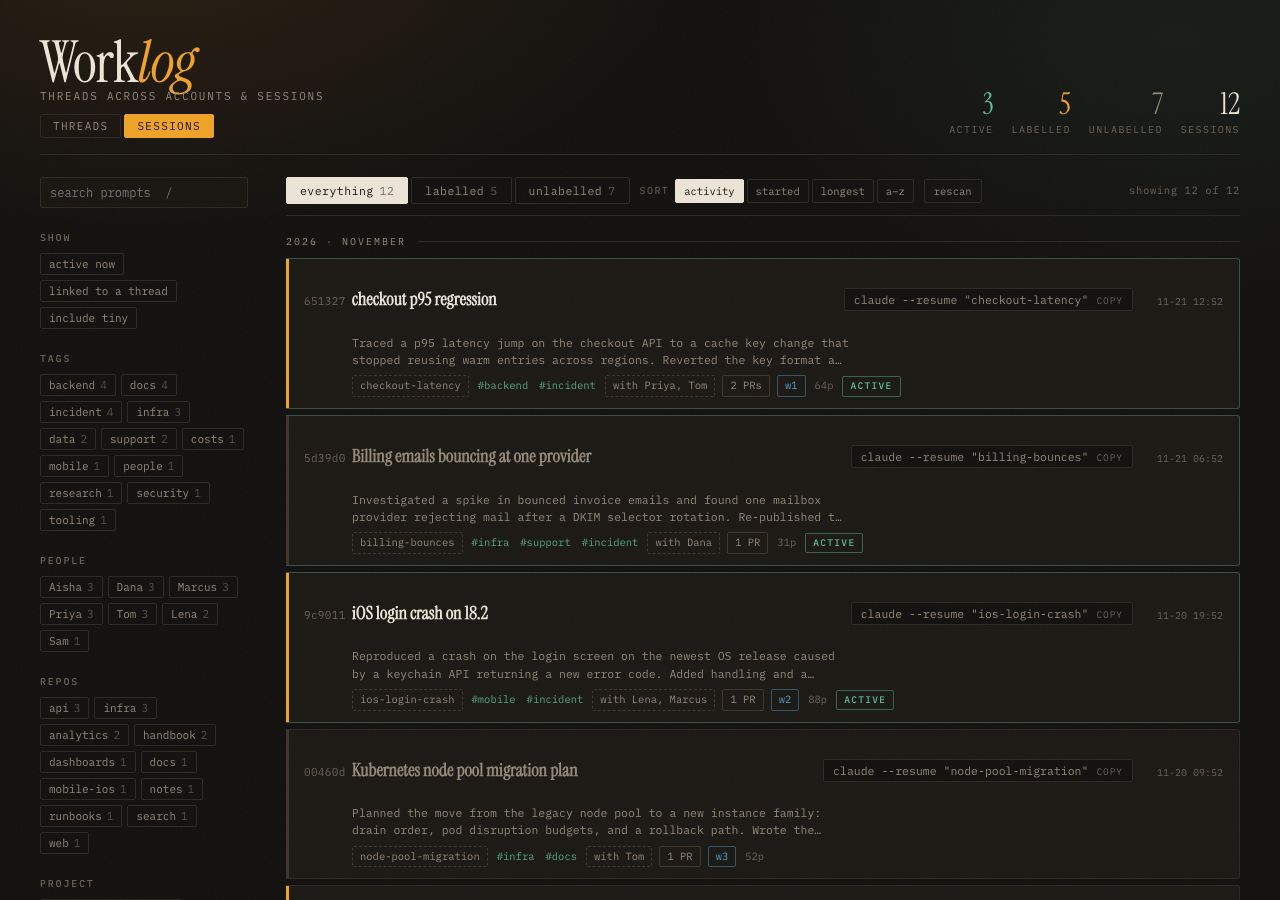

A local page, nothing leaves the machine. Every session, newest activity first, with its summary under the title and its resume command ready to copy. Search runs over everything I ever typed plus the summaries, so a half-remembered phrase finds the session even if I never named it. The rail filters by tag, by the person I was working with, by the repo that got edited. A session with activity in the last day shows as active, which in practice is the handful I am switching between this week.
The screenshot is invented data, for the obvious reason. The real one looks the same with more rows.
Open source
It is about three thousand lines, Python standard library and one HTML file, and it lives in a repository on my personal GitHub. Everything that tied it to my own setup moved into a small config file, so it should work for anyone with a Claude Code transcript directory. Check it out here.
The transcript format is Claude Code's private business and could change under me any day. I have made my peace with that: the scanner reads a handful of record types named in one place, and the summaries live in my own file keyed by session id, so a format change costs a rescan, not the catalog.
What I am still wondering
Has anyone else landed on long-running sessions per subject, and did you see the same effect? How do you find your old ones? And has anyone worked out what removes transcripts after a few months, because it was not the cleanup setting.